
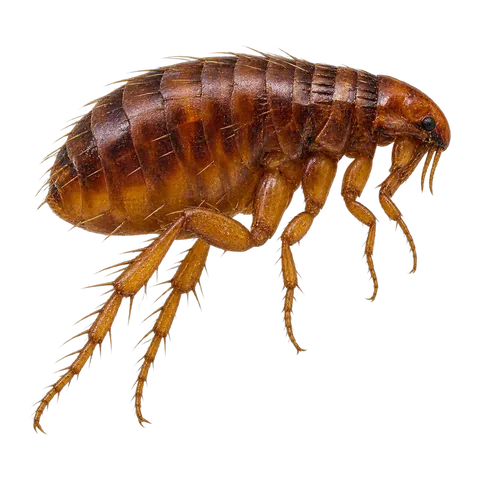
What fleas look like
Adult fleas are wingless insects about 2 to 3 mm long, dark reddish-brown and flattened from side to side, which lets them slip through fur. Their back legs are long and strong, and they can jump many times their own length. On a pale sock or a white sheet they show up as tiny dark specks that vanish in a jump.
Types of flea in UK homes
Several kinds of flea can turn up indoors:
- Cat fleas: by far the most common flea in UK homes. They live on cats and dogs and will bite people.
- Dog fleas: less common than cat fleas, even on dogs.
- Bird fleas: come from old nests in the eaves, the loft or a bird box near a window, often in spring once the birds have left.
- Hedgehog and rabbit fleas: sometimes picked up by pets in the garden, but they rarely settle in the house.
- Human fleas: rare in UK homes today.
The flea life cycle
Adult fleas live on the animal, feeding on blood and laying eggs in its fur. The eggs are smooth and fall off wherever the pet walks, sleeps and sits, so they end up in carpets, rugs, sofa cushions, pet beds and the gaps between floorboards.
The eggs hatch into small, worm-like larvae that move away from light, down into the carpet pile and under furniture. They feed on the dried blood in flea droppings. After a week or two each larva spins a sticky cocoon, which picks up dust and fibres and is very hard to see.
Inside the cocoon, the young flea can wait for weeks or months until it senses vibration, warmth or the breath of a passing animal or person. Then it hatches quickly and jumps on. At any one time, most of the fleas in a home are eggs, larvae and cocoons in the furnishings, and only a small share are adults on the pet.
Why fleas appear in empty homes
People who move into a house that has stood empty, or come back from a long holiday, are sometimes bitten around the ankles within a day or two. Fleas in their cocoons have been waiting since the last pet lived there, and the footsteps of new people make them hatch all at once. This can happen to people who have never owned a pet. Thorough vacuuming and a treatment of the whole property usually clear it.
Risks to people and pets
Flea bites on people are small, itchy red spots, often in groups around the ankles and lower legs. Most fade within a few days, though scratching can lead to infection.
Pets can suffer more. Some develop an allergy to flea saliva, with sore, bald patches and constant scratching. Fleas also carry tapeworm larvae, and a pet that swallows a flea while grooming can pick up a tapeworm. Young, old or small animals with a heavy flea burden can become weak from blood loss. Your vet can advise on treating your pets.
When to call a professional
If you have seen the odd flea and your pets are treated, a few weeks of daily vacuuming and hot washes of pet bedding may be enough. If you are still being bitten after that, or you have moved into a home with fleas, a treatment of the floors and furniture kills the adults and larvae and stops the eggs developing. Please treat your pets with a vet product before we arrive. If fleas come back within 90 days of the treatment, the return visit is free.