
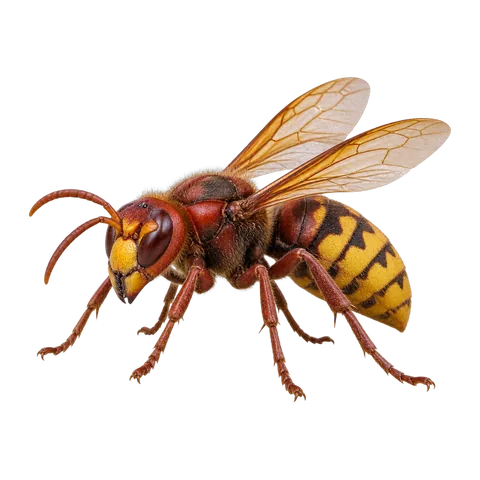
European hornets
The European hornet is the largest social wasp in the UK. Workers are about 2.5 cm long and queens up to 3.5 cm. The body is chestnut brown and yellow, with a reddish-brown head and chest and a yellow face, and the deep, heavy buzz in flight is easy to recognise.
European hornets nest in hollow trees, wall cavities, chimneys, sheds, lofts and large bird boxes. They fly at night as well as by day and are drawn to lit windows in late summer. They are calmer than common wasps and rarely sting away from the nest.
Asian hornets
The Asian hornet is an invasive species that has spread through much of Europe and has been found in parts of England, mostly in the south and south east. It is a little smaller than the European hornet and much darker. The body is mostly black or very dark brown with one wide yellow-orange band near the tail end, the face is orange, and the legs are yellow at the tips, as if dipped in paint.
In spring the queen builds a small nest in a sheltered spot such as a shed, a porch or a bush. In summer the colony often moves to a much larger nest high in a tree. Asian hornets hover outside beehives to catch honey bees, which is why every sighting matters.
If you think you have seen one, keep away from any nest. Take a photo if you can do so safely and report it to the Non-Native Species Secretariat through the Asian Hornet Watch app, so the national team can confirm it and deal with the nest.
Bees, wasps and hornets compared
Most stinging insects around a house fall into one of these groups:
- Honey bees: about 1.2 cm, slim, golden to dark brown and slightly hairy. They often arrive as a swarm hanging in a cluster in late spring.
- Bumblebees: round, fluffy and bulky, with bands of black, yellow, white or ginger. They nest in bird boxes, compost heaps and under sheds, and are slow and calm.
- Wasps: 1 to 2 cm, smooth and shiny, bright yellow and black, with a narrow waist and wings folded along the body at rest.
- European hornets: 2.5 to 3.5 cm, brown and yellow, with a deep buzz.
- Asian hornets: mostly black with one orange-yellow band and yellow leg tips.
- Hornet hoverflies: large, harmless flies that look like hornets, with short antennae, big eyes and no narrow waist. They hover in one spot.
How a hornet nest grows
Hornets follow the same yearly pattern as wasps: a queen starts a small paper nest in spring and the colony grows until late summer. A European hornet nest holds a few hundred hornets at its peak, while an Asian hornet nest high in a tree can hold several thousand. In autumn the colony dies and the empty nest is not used again.
Hornet stings
A hornet sting is painful, but the venom is no more harmful than a wasp's, and European hornets sting far less often. Most stings happen when someone knocks a nest, blocks the entrance or traps a hornet against the skin. Keep out of the flight path to a nest and do not swat at hornets near it. As with any sting, call 999 if someone has trouble breathing, swelling of the face or throat, or feels faint.
When to call a professional
A European hornet nest high in a tree or at the far end of a large garden can often be left to die off in autumn. One in a wall by a door, a shed used every day or a loft above a bedroom is usually worth treating. We confirm the species first. European hornet nests are treated with insecticide dust, honey bees and bumblebees are left alone or passed to a beekeeper, and a suspected Asian hornet is reported to the NNSS. Send us a photo on WhatsApp if you are not sure which you have.