
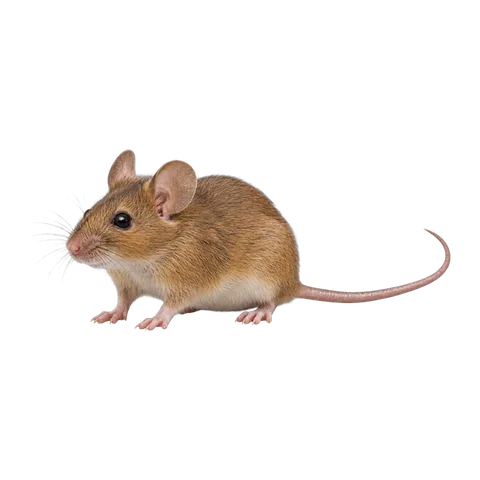
House mice
The house mouse is the mouse most often found living indoors all year. It is small and slim, about 7 to 9 cm long without the tail, with grey-brown fur that is only a little paler underneath. The tail is about as long as the body and looks scaly, the ears are fairly large and the eyes are small. House mice have a strong, stale smell, and a room they have lived in keeps it for some time.
House mice can spend their whole lives inside a building, in wall cavities, floor voids, kitchen units and lofts, and many never go outside.
Wood mice
The wood mouse, which most people call the field mouse, lives in gardens, hedges, fields and woodland across the UK. It is sandy or warm brown on top with a white or pale grey belly, and it has large dark eyes, big ears and a long tail. Wood mice hop and leap more than house mice, and they have a much milder smell.
They come indoors mostly in autumn and winter, into garages, sheds, kitchens and lofts close to open ground, and many head back out in spring.
Yellow-necked mice
The yellow-necked mouse looks like a large wood mouse with a band of yellow-brown fur across the chest, like a collar. It lives mainly in the south of England and along the Welsh border, often near old woodland. Yellow-necked mice are strong climbers and often end up in lofts and the upper floors of houses near woods, where they can be noisy at night. They also store nuts and seeds in hidden places, sometimes in large amounts.
How mice breed and behave
Mice breed quickly. A female house mouse can have her first litter at about two months old, then a litter of five to eight every few weeks. Indoors, with warmth and food, house mice breed all year. Wood mice and yellow-necked mice breed mainly from spring to autumn.
Mice are curious and will explore anything new, which is the opposite of rats. They take small amounts of food from many places, and most stay within a few metres of their nest. This is why several traps set close together along the walls where mice run work better than one or two traps in the middle of a room.
Health risks and damage
Mice leave urine and droppings wherever they go, including on worktops, in cupboards and in stored food. They can spread salmonella and other bacteria that cause food poisoning, and their urine and dander can trigger allergies and asthma in some people.
Their front teeth never stop growing, so they gnaw all the time. Chewed cables in lofts, under floors and behind appliances can cause electrical faults and fires. Mice also spoil stored clothes, papers and loft insulation by shredding them for nests.
When to call a professional
A wood mouse that has wandered into the garage in autumn may leave again on its own once the gaps are closed. House mice in the kitchen, or yellow-necked mice running in the loft every night, rarely do. We identify which mouse you have, set traps where they are running and use bait in locked boxes only where traps are not enough. A photo of the droppings on WhatsApp often tells us what you are dealing with before we visit.