
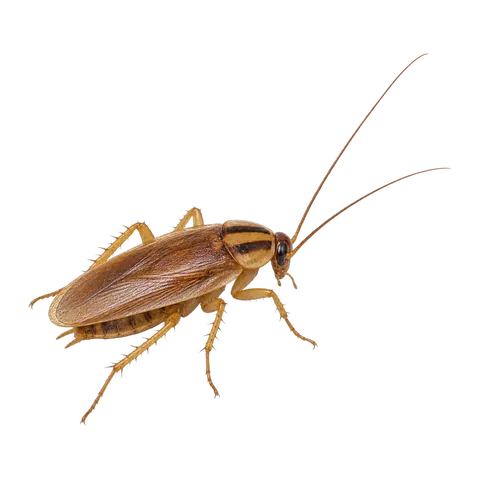
German cockroaches
The German cockroach is the smaller of the two, about 1.2 to 1.5 cm long and light yellowish-brown, with two dark stripes on the shield behind the head. Adults have full wings but rarely fly. Sticky pads on their feet let them climb smooth walls, glass and the sides of appliances with ease.
German cockroaches like warmth and stay close to food and water. They hide in tight gaps in and behind cookers, fridges, dishwashers, microwaves, kettle bases and the hinges of kitchen cupboards, high up as well as at floor level.
Oriental cockroaches
The Oriental cockroach is larger, about 2 to 2.5 cm long, and dark brown to shiny black. Males have wings that cover most of the body, and females have only short wing stubs. Neither can fly, and they struggle on smooth surfaces, so they are often found stuck in baths, sinks and smooth-sided bins.
Oriental cockroaches prefer cooler, damp places. They live in drains, cellars, floor voids, ducts and boiler rooms, and they tend to stay at ground level and below. They are most active in the warmer months, when they turn up in ground-floor kitchens and bathrooms.
Nymphs and egg cases
Young cockroaches, called nymphs, look like small adults without wings. German nymphs are dark with a pale stripe down the back, and Oriental nymphs are reddish to dark brown. They shed their skins several times as they grow, and the empty skins are one of the things we look for on an inspection.
Both species lay their eggs in a hard brown case shaped like a tiny purse. A German cockroach carries hers on the end of her body until the eggs are almost ready to hatch, and each case holds around 30 to 40 eggs. An Oriental cockroach drops or glues her case, with about 16 eggs inside, in a hidden spot soon after making it. The case shields the eggs from most insecticides, which is why treatment carries on over several weeks.
How fast they breed
German cockroaches breed fastest. In a warm kitchen a nymph can become an adult in around two months, and each female produces several egg cases in her life. A few cockroaches carried in with a delivery or a second-hand appliance can become a large infestation within months.
Oriental cockroaches are much slower, and their nymphs can take most of a year to grow up. Numbers build over seasons, so an Oriental problem is often found in an older building where it has been going on for some time.
Telling them apart at a glance
If you have seen one, these points usually settle which it is:
- Size: German about 1.5 cm, Oriental about 2.5 cm.
- Colour: German light brown with two dark stripes; Oriental dark brown to black.
- Place: German in warm kitchens, often at worktop height and above; Oriental at floor level, near drains and damp areas.
- Climbing: German runs up glass and tiles; Oriental gets trapped in baths and sinks.
- Season: German all year in heated buildings; Oriental mostly in spring and summer.
When to call a professional
Both species hide by day, so one seen at night usually means more out of sight. The species matters, as German and Oriental cockroaches live in different parts of a building and the bait has to go where each one feeds. We identify the species on the first visit and treat with gel bait and an insect growth regulator, with follow-up visits until activity stops. Send a photo on WhatsApp if you want to know which one you have before booking.