
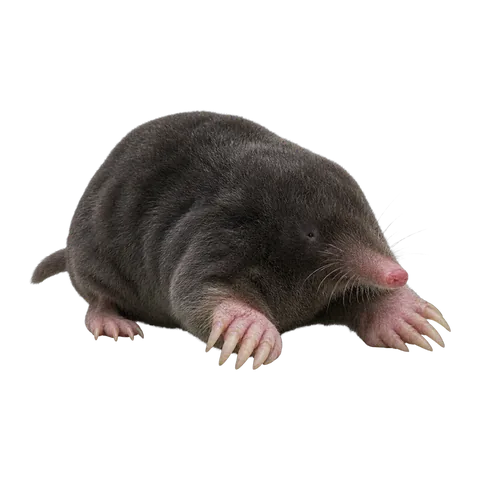
What a mole looks like
The European mole is the only mole in the UK. It is about 12 to 15 cm long, with a short tail, a pink, pointed snout and velvety black or dark grey fur. The fur has no grain and lies flat whichever way it is brushed, so a mole can move forwards or backwards in a tunnel without it catching.
Its front feet are broad and turned outwards like spades, with strong claws. The eyes are tiny and hidden in the fur, and there are no outer ears. A mole finds its way and its food by touch and smell, using fine whiskers and the sensitive tip of its snout. Most people only see one when a cat brings it in or it is found dead on a path.
Built for digging
A mole digs by pushing soil aside with one front foot at a time, then turns round in the tunnel and shoves the loose soil up a short shaft to the surface. That loose soil becomes a molehill. Deep tunnels run well below the lawn, while shallow runs just under the grass leave raised ridges. In very wet ground a mole may build an extra large mound, sometimes called a fortress, over its nest to keep it above the water.
What moles eat
Earthworms make up most of a mole's diet, along with beetle larvae, leatherjackets and other soil insects. The tunnels work like a trap: worms and insects fall into them, and the mole patrols the system to collect them. Moles need a lot of food for their size and cannot go long without eating.
In autumn and winter, moles store earthworms in underground larders. They bite the front end of each worm, which leaves it alive but unable to crawl away.
Territory and breeding
Moles live alone and defend their tunnels against other moles, except for a short breeding season in spring. Males dig long tunnels at that time to find females, which is often when a garden sees a sudden rush of new molehills. The female has one litter a year of around three or four young, in a nest of dry grass and leaves deep in the tunnel system.
The young leave the nest at about five weeks old and cross open ground in early summer to find a territory of their own. Many are taken by owls, buzzards, herons, foxes and cats at this stage. A mole that survives can live for three years or more.
Moles and the law
Moles are not a protected species in the UK, but they are wild mammals, and the Wild Mammals (Protection) Act 1996 makes cruelty to them an offence. Strychnine, once used on moles, has been banned since 2006. In many places moles do some good, mixing and draining the soil and eating leatherjackets and other larvae that damage grass roots. On farmland, woodland edges and wilder parts of a garden they can often be left alone.
When to call a professional
If moles are throwing up hills across a lawn, a bowling green, a paddock or a vegetable patch, trapping is the method that works. Because each mole lives alone, a lawn full of molehills usually needs only a few traps in the right runs. We probe for the tunnels in use, set traps below ground and lift every trap at the end of the job. If a new mole moves in within 90 days of the last treatment, we come back free.