
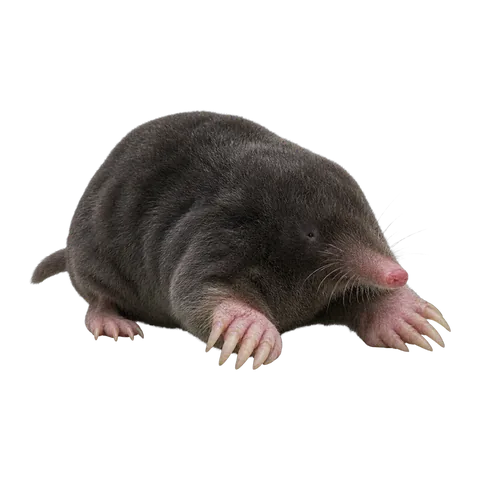
Signs of moles
The clearest sign is molehills: piles of fine, loose soil pushed up onto the lawn, often in a line. You may also see raised ridges where a mole has tunnelled just under the surface, especially in soft or freshly dug ground. Moles themselves are rarely seen, as they spend almost all their time underground.
How moles live
Moles live alone in a network of tunnels and patrol them for earthworms and insect larvae that drop in. One mole can throw up a lot of molehills, so a lawn covered in them may have only one or two moles. They are active day and night all year, and most molehills appear in autumn, winter and spring when the soil is moist.
Young moles leave home in early summer and look for new ground, which is often when a garden gets its first molehills.
Moles or something else
A molehill has no open hole in it, because the soil is pushed up from below. An open hole with soil scattered around it is more likely a rat, rabbit or vole burrow. Lawn torn up in small patches points to birds, badgers or foxes digging for grubs, and badgers are protected by law.
The problems moles cause
For most gardens moles are a nuisance more than a danger, but they can cause:
- Molehills on lawns and sports turf that are hard to mow over and blunt mower blades.
- Loosened roots under seedlings, young plants and vegetable beds.
- Soil mixed into silage or hay on farms and paddocks, which can spoil it.
- Uneven ground and collapsed tunnels that can cause trips for people and horses.
What you can try yourself
Home remedies such as plastic windmills, bottles and sonic spikes have little lasting effect. Rolling the lawn in spring and spreading molehill soil over bare patches keeps the surface level. If you only have a few molehills at the edge of the garden, it can be easiest to wait, as moles sometimes move on. Strychnine, once used on moles, has been banned in the UK since 2006, and there is no poison you should put down for them.
When to call a professional
If molehills keep appearing on a lawn, a paddock or a vegetable bed, trapping in the active tunnels is the most reliable method. We find the runs in use, set traps underground out of reach of children and pets, and use no poison. Send us a photo of the molehills on WhatsApp if you want to check it is moles before booking.