
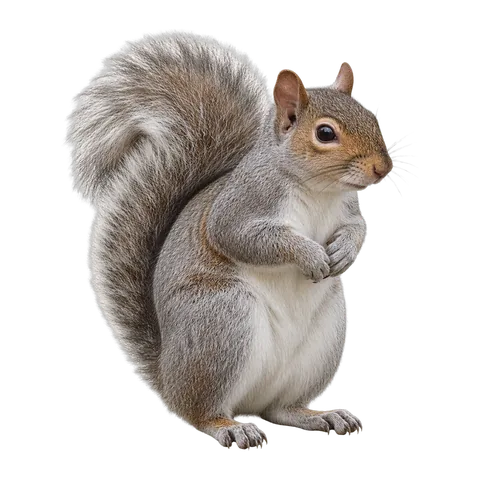
Grey squirrels
The grey squirrel was brought to Britain from North America in the 1800s and now lives across most of England and Wales and much of Scotland. Its body is about 25 cm long, with a bushy tail almost as long again. The fur is silver-grey, often with a brown tinge along the back and sides in summer, and the belly is white. Grey squirrels have no ear tufts. They live in woods, parks and gardens and are often seen on fences, bird feeders and roofs.
Red squirrels
The red squirrel is native to the UK. It is smaller and lighter than the grey, with russet to chestnut-brown fur, a pale belly and tufts on the ears that are easiest to see in winter. Some red squirrels are quite dark, so the ear tufts and smaller size are better clues than colour alone.
Red squirrels are now found mainly in Scotland, parts of northern England such as Cumbria and Northumberland, and a few places further south including Anglesey, the Isle of Wight and Brownsea Island. They are protected by law, so they must not be trapped or harmed and their dreys must not be disturbed. If you think red squirrels are using a building, ask for advice before doing anything.
Why grey squirrels cause harm
Grey squirrels are the main reason red squirrels have gone from most of the UK. Greys are bigger, can live well on acorns that reds struggle to digest, and do better in mixed and broadleaf woods. Many greys also carry squirrelpox, a virus that does them little harm but kills red squirrels.
Grey squirrels strip bark from young trees such as beech, oak and sycamore, which can kill or deform them, and they take eggs and chicks from birds' nests.
How squirrels live and breed
Squirrels are active by day and busiest in the morning and late afternoon. They do not hibernate, but they spend longer in the nest in cold or wet weather. The nest, called a drey, is a ball of twigs and leaves high in a tree, lined with moss, grass and shredded bark. A loft gives them the same things, dry and warm, with insulation to tear up.
Grey squirrels can breed twice a year, with young born in early spring and again in summer. A litter is usually three or four, and the young stay in the nest for around ten weeks. In autumn, squirrels bury nuts and seeds one at a time across a wide area and dig them up through the winter, which is why they leave small holes in lawns and pots.
Grey squirrels and the law
Grey squirrels are listed as an invasive species. Once one is caught, it is an offence to release it or let it go anywhere else, so it has to be dispatched humanely, and traps must be checked at least once every 24 hours. A live-catch trap from a shop is not a way to move squirrels to a park or wood. If squirrels are already in the roof, keep the loft hatch shut and leave the hole they use open while they are inside.
When to call a professional
Squirrels in the garden are part of life in most of the UK, and squirrel-proof feeders and netting over pots solve most problems. Squirrels in the loft or wall are different, as they chew timbers and cables and rarely leave once settled. We confirm the species, remove grey squirrels by legal methods and close the holes with mesh or metal sheet. If the noise is loud and at night, from early summer to autumn, it may be edible dormice, and we can check for those too.