
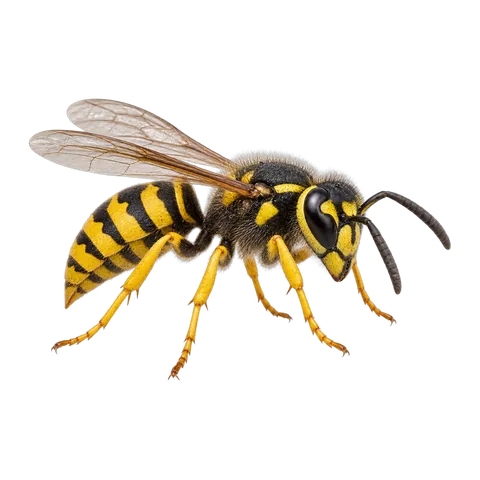
What wasps look like
The wasps that build nests around UK homes are mostly common wasps and German wasps. Workers are about 1.2 to 1.7 cm long, with a smooth, shiny body in bright yellow and black bands and a narrow waist between the chest and the abdomen. Queens look the same but are bigger, close to 2 cm. At rest, wasps fold their wings flat along the body.
The two species are hard to tell apart without a close look at the markings on the face, and they behave in much the same way.
A wasp colony's year
A wasp nest lasts for one season. The year runs roughly like this:
- Spring: a queen wakes from hibernation, feeds on nectar and starts a nest the size of a golf ball from chewed wood mixed with saliva.
- Late spring: she raises the first workers herself. Once they hatch, she stays in the nest laying eggs while the workers build and forage.
- Summer: the nest grows fast and can hold several thousand wasps by August.
- Late summer: the colony raises new queens and males, which leave the nest to mate.
- Autumn: the old queen and the workers die off. Only the mated new queens survive, hibernating in sheds, lofts, log piles and the folds of curtains.
Where wasps nest
Queens look for a dry, sheltered space with a small way in and out. Common sites are lofts, gaps under roof tiles and in the eaves, wall cavities reached through an air brick, sheds and garages, bird boxes, hedges and dense shrubs, and old rodent burrows in the ground. A nest in a hedge or a lawn is easy to disturb by accident with a mower or hedge trimmer, and that is when many people get stung.
An old nest is not used again. Each queen picks a new site in spring, although the same roof can attract a new queen year after year.
Why wasps get bolder in late summer
In spring and early summer, worker wasps hunt caterpillars, flies and other insects to feed the larvae. In return, the larvae give the workers a sugary liquid. Once the colony stops raising young in late summer, that supply ends, and the workers go looking for sugar elsewhere. That is when wasps start turning up at picnics, bins, fallen fruit and cans of fizzy drink.
Wasps do some good in the garden, as they eat large numbers of pest insects and pollinate some plants. A nest well away from where people walk can often be left to die off in autumn.
Stings and safety
A wasp can sting more than once. A wasp that is swatted or crushed gives off a scent that can bring others from the nest, so it is better to move away slowly. Near the nest, wasps defend it hard, and vibration, blocking the entrance or knocking the nest can bring many out at once.
Most stings cause pain, redness and swelling that settle within a day or two. Call 999 if someone has trouble breathing, swelling of the face or throat, or feels faint after a sting.
When to call a professional
A nest by a door, a path, a window or a play area, or one that wasps are getting into the house from, is usually worth treating. We find the entrance, check that the insects are wasps and not bees, and puff insecticide dust into the nest. If the nest is still active 7 days after treatment, we come back free. If you are not sure what you have, a photo on WhatsApp is usually enough for us to tell you.