Why the two get confused
Clothes moths and carpet beetles both lay eggs on wool, silk, fur, feathers and other animal fibres, and in both cases the larvae do the damage. They like the same dark, undisturbed spots: the back of the wardrobe, under the bed, carpet edges behind furniture and boxes of stored clothes. Many homes have both at once.
Telling them apart helps you check the right places and use the right traps. The larvae, the marks they leave and the adults all look different once you know what to look for.
The larvae
Clothes moth larvae are creamy-white caterpillars about 1 cm long with a brown head. They spin silk as they feed, so you find fine webbing, silk tubes or small cases on the fabric, often with droppings the same colour as the material stuck to them.
Carpet beetle larvae, often called woolly bears, are 4 to 5 mm long, brown and covered in bristly hairs, with a tuft at the tail. They move in short bursts and curl up when disturbed. They leave no silk. What you find are their shed skins, like tiny empty brown husks, in drawers, along skirting boards and in the fluff under furniture.
The damage
- Clothes moths: grazed patches with webbing or silk on top, in hidden areas such as under collars, in the folds of stored jumpers and on rug edges under sofas.
- Clothes moths in carpets: the pile thins in patches and comes away when you brush it.
- Carpet beetles: neat, scattered holes with no webbing, often along seams, and bare tracks in carpet along the skirting.
- Carpet beetles: also found in airing cupboards, in lofts with old bird nests and under floorboards where dust and fluff collect.
The adults
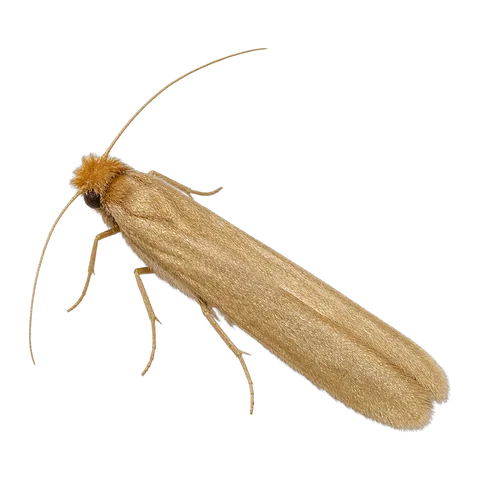
Clothes moths are small, about 6 to 8 mm long and golden-buff. They avoid light and tend to run or flutter low into dark corners. You see them most in wardrobes and in rooms that are not used much.
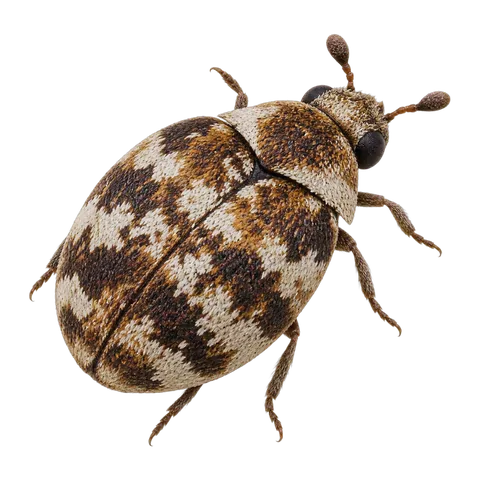
Adult carpet beetles are round, 2 to 4 mm long and mottled brown, white and yellow, a little like a very small patterned ladybird. They are drawn to light, so you find them on windowsills from spring to late summer. Outdoors they feed on pollen, and they often come in from the garden to lay eggs.
What this means for checking and treating
Moth pheromone traps catch male clothes moths and show where they are and roughly how many. They do not catch carpet beetles, so an empty trap does not mean you are clear if you keep finding woolly bears or shed skins.
For both pests, the first steps at home are the same. Vacuum carpet edges, under beds and inside wardrobes, then empty the vacuum outside. Wash affected items at the hottest temperature the fabric allows, or seal them in a bag and freeze them for about a week. For carpet beetles, check the loft for old bird nests and clear them, as they are a common breeding spot. The larvae's hairs can irritate skin, so wear gloves when you handle them.
When to call a professional
Call a professional if you keep finding larvae after a few weeks of cleaning, if damage is spreading across carpets in more than one room, or if you cannot find where they are breeding. A technician can identify the pest from a larva or shed skin, find the source and treat carpets, floor edges and voids.
Keep people and pets out of treated rooms until the floors are dry, usually two to three hours. Quotes are free, and if the problem comes back within 90 days of the last treatment, the return visit is free. A clear photo of a larva sent on WhatsApp is often enough for us to tell you which one you have.