Why every sighting matters
The Asian hornet is not native to the UK and feeds on honey bees and other insects. Each confirmed sighting helps the national response trace the hornets back to their nest and destroy it before new queens leave in autumn. A single clear report from a garden can lead to a nest being found that nobody had spotted.
Reports are handled by the Non-Native Species Secretariat (NNSS). You do not need to be sure of what you saw. A report with a photo is checked by people who know the species well, and a report that turns out to be a native insect still helps.
What to note before you report
A good report is short and exact. Try to gather these details while the sighting is fresh.
- A photo, even a blurry one taken from a distance. Do not move closer to get a better shot.
- Where you saw it, as precisely as you can: a postcode, a street or a point on a map.
- The date and roughly what time it was.
- What it was doing, for example hovering in front of a hive, feeding on fallen fruit or flying in and out of a hedge.
- How many you saw, and whether they all flew off in the same direction.
Sending the report
The quickest way is the free Asian Hornet Watch app, which lets you attach a photo and drops a pin where you are standing. If you do not use the app, the NNSS website has an online form that asks for the same details.
If you find a dead hornet, put it in a sealed jar or plastic box and keep it somewhere cool. You may be asked for it so it can be identified for certain.
Common look-alikes
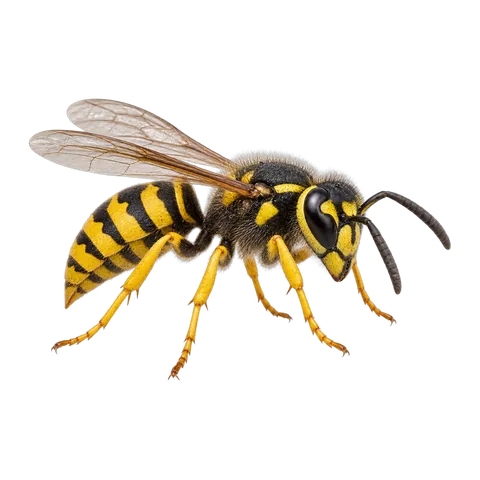
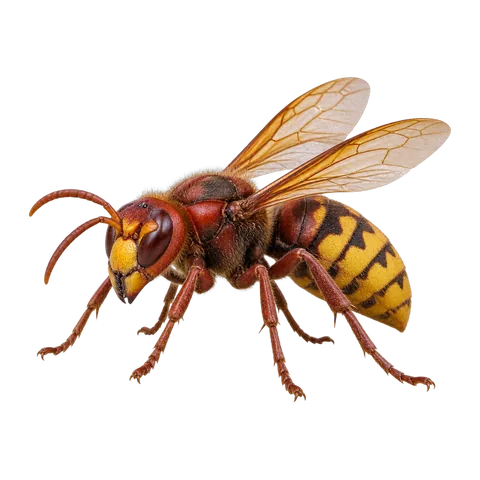
Many reports turn out to be the European hornet, which is larger, brown and yellow with a reddish head, and mostly yellow on the lower half of the body. The Asian hornet is darker, with a mostly black body, one wide orange band near the tail and yellow tips to its legs.
The hornet mimic hoverfly and the giant woodwasp also cause confusion. The hoverfly has short antennae and hovers in place, and the woodwasp has a long, straight tail spike. If you are not sure, report it anyway with a photo.
What not to do
Do not try to find or destroy a nest yourself. Asian hornets defend their nest strongly, and a disturbed nest can leave hornets that are harder for the response team to trace. Do not spray insecticide into hedges or trees where you think a nest might be.
Keep children and pets away from any area where you have seen several hornets flying in and out. Large nests are often high in trees and only become visible once the leaves fall.
What happens after you report
Experts look at your photo and details. If the sighting is confirmed, the response team may visit the area to look for more hornets and follow them back to the nest, which is then destroyed. You might be contacted with questions, so keep your phone to hand for a few days after reporting.
When to call a professional
If you have a hornet nest and you are not sure what kind it is, ask a professional before anyone goes near it. A technician can tell a European hornet nest from a suspected Asian hornet nest. We treat European hornet nests that put people at risk, and if we suspect Asian hornets, we report them to the NNSS and leave the nest for the national team.
You can send us a photo on WhatsApp for a quick opinion. Quotes are free and there is no call-out charge.