Wasps, bees and hornets
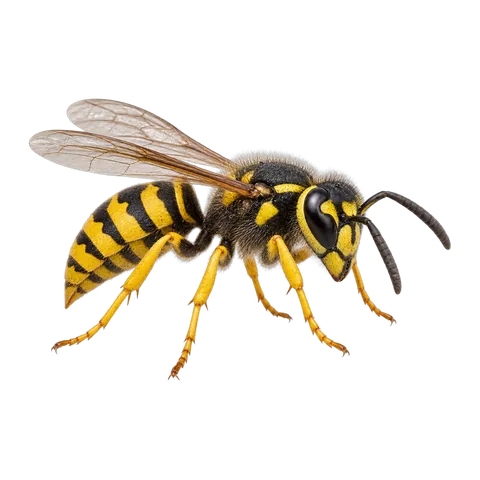
Check what you have before you do anything. Common wasps are bright yellow and black with a narrow waist and few hairs. Their nests are papery and grey or beige, made from chewed wood, and found in lofts, wall cavities, sheds, hedges and holes in the ground.
Bees are hairier and rounder. We do not destroy honey bees or bumblebees. A local beekeeper may be able to collect a honey bee swarm, and bumblebee nests usually die out by late summer, so they can often be left.
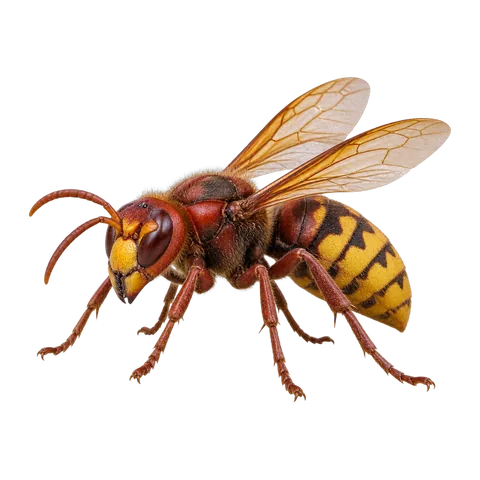
The European hornet is a native species, larger than a wasp and brown and yellow. The Asian hornet is darker, mostly black with a yellow-orange band near the tail and yellow-tipped legs. If you think you have seen one, report it to the Non-Native Species Secretariat using the Asian Hornet Watch app, with a photo if you can take one safely.
The life of a wasp nest
A nest is started in spring by a single queen. It grows through the summer, and by late summer a large nest can hold thousands of wasps. In autumn the workers die off and new queens leave to hibernate elsewhere.
Old nests are not reused the next year. An empty nest found in winter does not need treating, though you can remove it if you want to. Late summer is when wasps are most noticeable around food and drinks.
Things to avoid
- Do not block the entrance. Wasps may chew a new way out, sometimes into a room.
- Do not hit, poke or knock down the nest.
- Do not pour water, petrol or anything flammable on it, or try to burn it.
- Do not stand in the flight path at the entrance or use noisy garden tools next to it.
- Do not climb a ladder near an active nest, as a sting can cause a fall.
Nests that can be left
If a nest is in a part of the garden you rarely use, high in a tree or away from doors and windows, and nobody in the house is allergic, you can leave it. It will die off in autumn. Wasps also eat garden insects such as caterpillars and aphids.
Have it treated if it is near a door, window, path or play area, inside the house, or if anyone in the household has had a severe reaction to a sting. Anyone with signs of a severe reaction, such as swelling of the face or throat or difficulty breathing, needs emergency help on 999.
When to call a professional
Call a professional if the nest is near where people walk or sit, inside a loft or wall, hard to reach, or if you are not sure whether it is wasps, bees or hornets. Shop-bought powders and sprays put the person using them close to an active nest.
A technician treats the nest entrance and the wasps carry the insecticide inside, and activity usually drops within a day or so. Send us a photo or short video of the entrance on WhatsApp so we can confirm what it is. Quotes are free, there is no call-out charge and we aim to visit on the same or next day.