
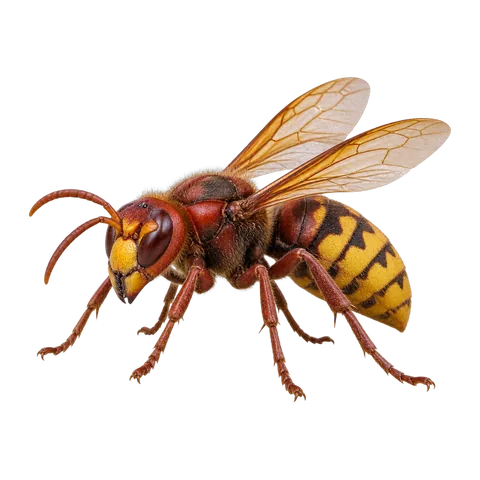
At a glance
- What it looks like
- Smaller and darker than the native European hornet, with a mostly black body, one wide yellow-orange band near the tail and yellow tips to the legs. Workers are up to 25 mm long.
- Where you find it
- Most UK sightings are in the south and south east of England, especially Kent. Small nests are built in sheds and bushes in spring, and larger ones high in trees from summer.
- Is it harmful?
- Its sting is similar to that of other hornets and wasps. It is an invasive species that preys on honey bees and other insects.
- What to do
- Do not disturb a nest or try to kill the hornets yourself. Report any sighting, with a photo if you can take one safely, to the Non-Native Species Secretariat through the Asian Hornet Watch app or its online form.
Life cycle and nests
A queen that has survived the winter starts a small primary nest in spring, often in a shed, porch, hedge or roof space. As the colony grows in early summer, many move to a much larger secondary nest, usually high in a tree, which can be hard to spot until the leaves fall. In autumn the nest raises new queens, which leave to mate and spend the winter hidden, and the old nest then dies.
Asian hornet or European hornet
The European hornet is larger, up to about 35 mm, with a brown and yellow body and a mostly yellow abdomen. The Asian hornet is darker, with a black abdomen, one broad orange-yellow band and legs that are yellow at the ends. Large wasps and the hornet hoverfly are often mistaken for it, so a clear photo is the best way to confirm a sighting.
Why reporting matters
Each nest found early stops a new set of queens leaving in autumn. Confirmed reports are passed to the teams that track hornets back to their nests and remove them. Note where and when you saw the hornet, and whether it was near beehives.
Questions about asian hornet
Should I set traps for Asian hornets?
Leave trapping and nest removal to the official response teams. Homemade traps often catch native insects, and going near a nest puts you at risk of stings.
Is the Asian hornet more dangerous than other hornets?
A single sting is similar to that of other hornets and wasps. The risk rises if a nest is disturbed, as many hornets may defend it at once.
What if I find a nest in my garden?
Keep people and pets away and do not touch it. Report it through the Asian Hornet Watch app, with a photo if you can take one from a safe distance.